
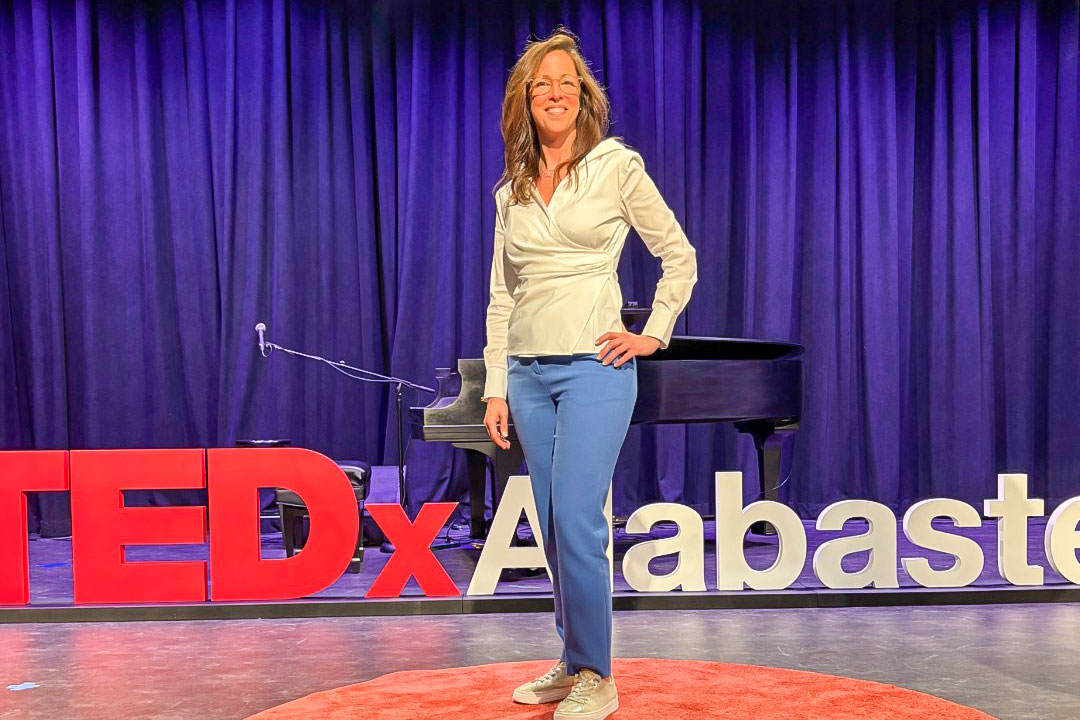
When Dr. Heather Ashley Hayes walked into her eye doctor’s office for a routine checkup, she expected the usual: a few uncomfortable flashes of light, the puff of air that startles the eye, perhaps the dilation drops that require sunglasses indoors for the rest of the day. Instead, she walked out with news that would change her life forever.
Her doctor had noticed something unusual and suggested further tests. An MRI revealed a baseball-sized tumor wrapped around her carotid artery and optic nerve. Within days, Hayes was thrust into a medical crisis that few people are prepared to face. What followed was a 20-hour surgery, a long stay in the ICU and a year of painstaking rehabilitation.
Doctors warned her that many of the basic abilities she had built her life around like walking, talking, reading and writing might be gone forever. As a professor of communication and information sciences, those abilities were not just personal; they were central to her career, her identity, her way of engaging with the world. After months of physical and occupational therapy, she slowly began to regain them. She survived, but not without permanent loss of sight in her right eye and the hearing in her right ear.
What she gained, however, was harder to measure but perhaps even more significant. Through her recovery, Hayes noticed what she calls the “cracks” in the way the world is designed, cracks she hadn’t been aware of before her diagnosis. For many individuals, she realized, the world is built in ways that quietly exclude, forcing people to navigate spaces, technologies and systems not made with them in mind.
In her recent TEDx talk in Alabaster, Alabama, Hayes recounts this story. She shares this not as a tale of personal triumph but as a way of reframing accessibility itself. Accessibility, she argues, has been miscast as a special accommodation for a select group of people – a ramp added to the side of a building, a caption track grudgingly applied, a compliance checkbox marked because the law requires it. But Hayes insists this misses the real point. “Accessibility isn’t a favor for those with special needs,” she says. “It’s simply making sure no one is left out.”
The heart of her argument is captured in the concept of universal design. This is the idea that if we create spaces, tools, and systems with inclusivity at their foundation, everyone benefits. To explain, Hayes turns to something so ordinary it is almost invisible – the curb cut. Originally designed to help wheelchair users transition from sidewalk to street, curb cuts are now ubiquitous. Travelers pulling suitcases, parents pushing strollers, cyclists hopping off bikes, workers hauling carts, all rely on them. In fact, the majority of curb cut users are not people in wheelchairs. The phenomenon has been so widely recognized that scholars coined the phrase “the curb cut effect,” describing how features built for accessibility end up benefiting the public at large.
For Hayes, this is more than a neat anecdote. It is a model for how society could function if accessibility were treated as the starting point rather than the minimum requirement. And yet, she warns, the policies that guide accessibility in the United States are decades out of date. The Americans with Disabilities Act was enacted in 1990 and has seen minor updates since. An amendment in 2008 broadened the definition of disability, and in 2024, updated rules about accessibility for web content and mobile application in governmental services were added. That means the legal framework for accessibility has yet to fully adapt to the massive changes and technological advances seen over the last 30 years.
“We’re still building our accessibility policy with rules from the fax machine era,” Hayes points out.
This framework, she argues, has created a “lowest bar” mentality in which organizations focus on doing only what the law demands—the very least they can—rather than pursuing changes that could transform experiences for all. She points out consequences are real: students forced to prove their disabilities through invasive procedures just to access resources, workers paid subminimum wages under loopholes that still exist, and communities deprived of innovations that would help everyone, disabled or not.

Hayes contrasts this mindset with examples of what happens when possibility drives design. She highlights tools like smart pens that combine handwriting with audio, creating searchable records that boost learning for students across the board. In study after study, these tools have been shown to improve outcomes not just for those with documented needs but for entire classrooms. This, she argues, is the true power of universal design – once you stop thinking of accessibility as a begrudging add-on, you unlock solutions that ripple outward to improve lives in unexpected ways.
Her own recovery is a testament to this philosophy. Despite the dire predictions, she walks, speaks and reads today. Preparing her talk was still a struggle, she admits, as reading remains a challenge. But rather than framing this as a limitation, she frames it as an opportunity to rethink how the world could work if designed differently. “Would we rather keep designing our world to accommodate a few, based on outdated rules?” she asks. “Or would we rather build one that begins with accessibility and unleashes innovation for everyone?”
That question lingers long after her talk ends. Hayes is not asking for sympathy or for society to meet the bare minimum required by law. She is asking us to see accessibility not as compliance, but as creativity. To see accessibility not as a burden, but as a chance to build better. When design begins with the assumption that no one should be left out, the results are innovations that surprise us, delight us and ultimately make life easier for everyone.
“When we design with compliance in mind, we get the bare minimum,” she says. “When we design with possibility in mind, we get innovations that change lives.”
Her story, which is one of survival and resilience, is reimagining what is possible. If a curb cut can reshape how entire cities move, what else might we create if accessibility were treated as the spark for invention rather than a grudging accommodation? Hayes leaves her audience with that open challenge. The choice is ours; she reminds us: a world designed to meet the lowest bar, or one bold enough to erase the idea of the impossible altogether.