
For one evening, decades of professional accomplishments and defining moments came together in celebration of four individuals whose careers have helped shape the fields of communication and information.
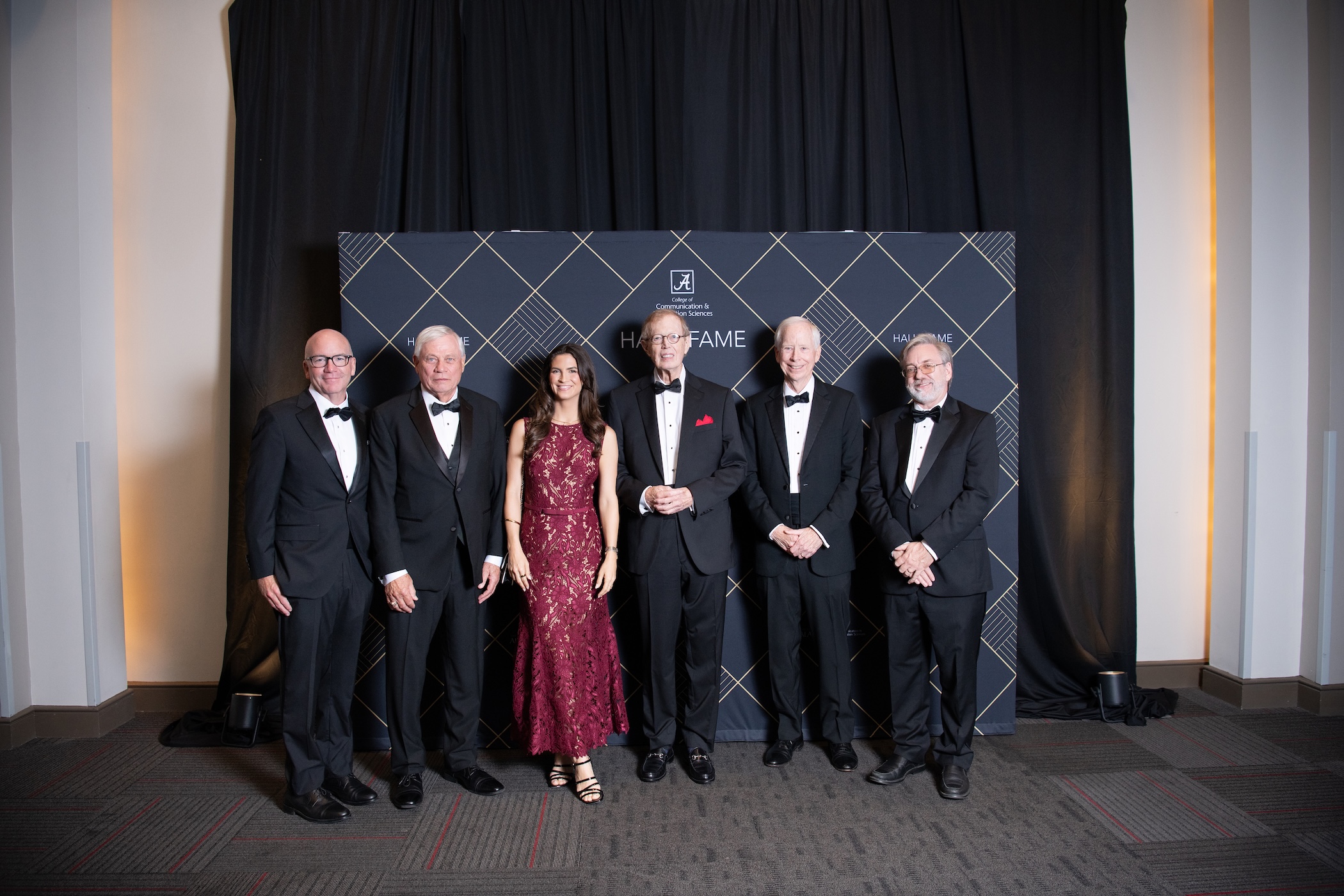
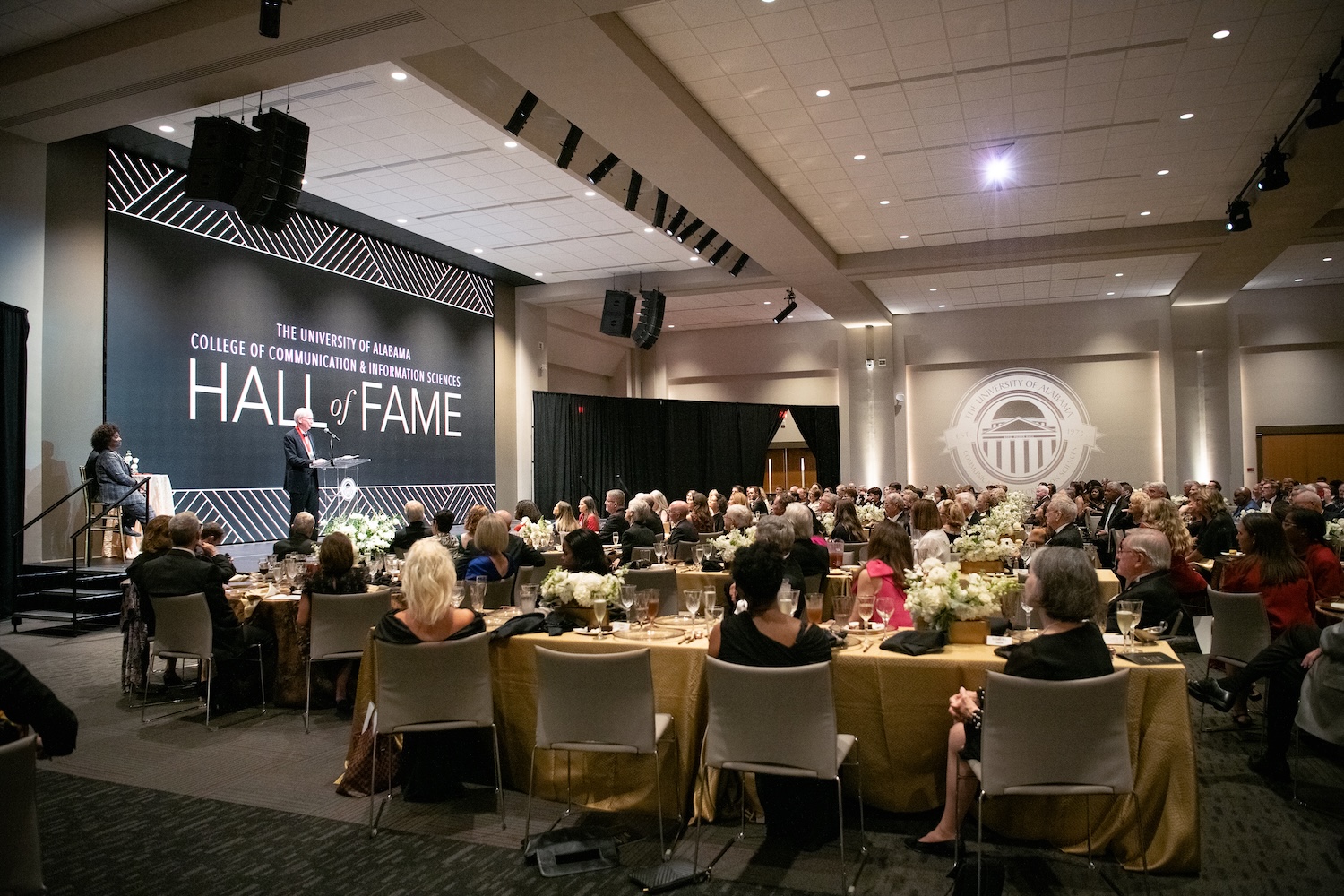
On October 15, 2026, The University of Alabama College of Communication & Information Sciences (C&IS) welcomed four new members into its Hall of Fame, recognizing their achievements in journalism, public relations and library and information studies. Surrounded by family, friends and members of the C&IS community, the inductees were celebrated for the careers they have built and the impact they have made on their respective professions.
The 2026 class included Stephen Bradley, Tom Scarritt, Jerry Stephens and Kaitlan Collins, each bringing a distinct professional journey to a shared honor.
The evening brought those accomplishments to life through special video tributes featuring reflections from the inductees themselves, along with their friends, families and colleagues. Each inductee was also presented with a commemorative Hall of Fame medal and recognized with a plaque that will join those of previous inductees in Reese Phifer Hall, where their contributions will remain part of the College’s history.
While their paths took them into different industries and leadership roles, the evening celebrated the common thread of lasting influence within the communication industry.

Stephen Bradley
Stephen Bradley’s induction into the C&IS Hall of Fame represents both the culmination of a career spanning more than five decades and recognition of the public relations profession he helped elevate.
Throughout his career, Bradley witnessed public relations evolve from a function often overlooked by organizational leadership into an essential part of strategic decision-making. His work helped establish a greater role for communications professionals in organizational leadership, a shift that gives his Hall of Fame induction particular significance.
“I look at it also as a recognition of the importance of the practice of public relations,” Bradley said. “I’ve seen the public relations function grow from something that was an afterthought years ago to a function that’s critical now.”
Bradley put that philosophy into practice during some of Alabama’s most challenging moments in corporate and public affairs. When he joined Alabama Power in 1978, the company faced intense political pressure and media scrutiny. Rather than simply responding to criticism, he worked alongside his team to strengthen relationships with journalists and build trust through accurate and transparent communication.
His commitment to those principles began long before his time at Alabama Power. As a young journalist serving in Vietnam, Bradley witnessed firsthand the importance of truthful reporting during times of uncertainty.
Those experiences reinforced his belief that journalists and public relations professionals share a responsibility to provide accurate information, even under difficult circumstances.
Beyond his professional achievements, Bradley credits much of his success to the people who stood alongside him. The relationships he built throughout his career, both personally and professionally, remain among the things he values most.
“I have been extremely fortunate and blessed in many ways,” Bradley said. “My wife, Evelyn, has been a critical part of this throughout, and I had a great support system.”

Tom Scarritt
The Hall of Fame has long held a special meaning for Tom Scarritt. Growing up in Tuscaloosa as the son of University of Alabama journalism professor Charles W. Scarritt, he became familiar with the journalists whose work helped shape the profession. Now, he joins their ranks alongside his father, a member of the Hall of Fame’s inaugural class.
“It is a huge and humbling honor to join the great Alabama journalists who are included in this Hall of Fame,” Scarritt said. “These are giants of the business whose names I heard at home growing up, as well as friends and mentors who helped me in my own career.”
Scarritt spent nearly four decades at The Birmingham News, rising through the newsroom to become editor and helping guide the newspaper through years of change and national recognition. Yet, when reflecting on his accomplishments, he is quick to acknowledge the people who worked alongside him.
“The most important lesson I learned over the years is success is a team effort,” Scarritt said. “It takes a lot of different talents to produce a good newspaper or website or television program.”
His connection to the College also extends into the classroom. Like his father, Scarritt helped prepare future journalists, serving as an adjunct professor at C&IS for nearly a decade. His experience in the newsroom shaped the lessons he shared with students, particularly about the responsibilities that come with entering the profession.
“I often reminded my students that a free and independent press is essential for democracy,” Scarritt said. “We cannot take that for granted; we have to protect that independence against any efforts by government to control the information people need to govern themselves.”
That commitment to journalistic independence has remained central to Scarritt’s work, connecting his decades in the newsroom with his efforts to prepare those who will carry the profession forward.
Jerry Stephens
Collaboration also played a defining role in the career of Dr. Jerry Stephens, whose work in higher education helped transform how academic libraries provide access to information.
Stephens began his career at the University of Alabama at Birmingham (UAB) in 1974, starting in the university’s library after serving in Vietnam. What began as an opportunity to enter higher education grew into a career spanning more than four decades, including nearly 30 years as director of the Mervyn H. Sterne Library. Behind that journey was an early mentor whose support helped shape his future.
“More importantly I had a great mentor, Dr. Paul Spence, that took a chance on a Vietnam veteran and hired me as the accountant for the library,” Stephens said. “He helped me evaluate career choices that gave me so many opportunities.”
With Spence’s encouragement, Stephens went on to earn an MBA, a master’s degree in library science and a doctorate, opening the door to leadership opportunities that would shape academic libraries across Alabama.
During his tenure at UAB, Stephens helped guide the Sterne Library through a major technological transformation. The changes required staff to rethink familiar processes and embrace new ways of managing information, an effort Stephens considers one of the defining accomplishments of his career.
“I am most proud of how the library staff accepted the challenge that technology presented,” Stephens said. “The staff went from producing catalog cards on IBM selective typewriters to building a totally digital database of all of the library’s holdings.”
His influence extended across the state through his involvement in establishing the Network of Alabama Academic Libraries and the Alabama Virtual Library, initiatives that strengthened collaboration and access to information. Those efforts became an important part of his professional legacy, though recognition was never what motivated the work.
“When I was involved with the creation of the Network of Academic Libraries and the Alabama Virtual Library, I never imagined or even thought about being honored in this way,” Stephens said.
His career also reinforced a lesson he hopes future generations will carry forward: meaningful change is possible through thoughtful planning and collaboration.

Kaitlan Collins
Kaitlan Collins has built a career reporting on history as it unfolds, seeking answers from some of the most powerful figures in the world. Her experiences have given her a deeper understanding of the responsibility that comes with documenting moments that will shape the future.
As a CNN journalist covering the White House and national politics, Collins has reported on some of the most consequential events in recent history. Her work has given her a front-row seat to history, offering a perspective on major events that differs from how they are often understood years later.
“When you are a student and you’re learning about history, these big moments you feel like everyone understood when they were happening that they were big moments,” Collins said. “But actually, you don’t always know when you’re in the middle of it and you’re on the cusp of history and things are happening in that moment, and you’re reporting on it in real time.”
That understanding carries into her approach to interviewing powerful figures in government. Whether questioning elected officials or navigating a difficult exchange, Collins recognizes that pursuing meaningful answers sometimes requires challenging the expectations of those in the room.
“I think you have to get comfortable being uncomfortable,” Collins said. “You have to kind of get used to there being a little bit of tension and awkwardness, maybe some silence, and being willing to be that person in the room who is bringing up the elephant in the room, so to speak.”
Even as technology reshapes the media landscape, Collins believes the fundamental responsibility of journalists remains unchanged.
“I think that no matter what platform you’re using or what medium you’re using, the job is always the same for all reporters, which is to report the truth, to hold powerful people to account,” Collins said. “No matter how the actual way you do your job changes, that core mission of what you’re doing always stays the same.”

The four inductees reflect the breadth of disciplines represented within C&IS and the lasting influence of The University of Alabama. Though their careers followed different paths, each emphasized the importance of the people, experiences and principles that shaped their professional journeys.
The 2026 Hall of Fame celebration honored those contributions while reinforcing the College’s commitment to preparing future generations to make their own impact. As the newest inductees joined those recognized before them, their achievements became part of a tradition that continues to connect the College’s history with its future.